
The Risk Intelligence Stack: An Architecture for Risk-Aligned Cyber Operations
Four layers, one engineering thesis, and the framework I’ve been building for senior cyber consulting work.
Most cybersecurity programs were assembled. The few that work were engineered.
The difference is not vocabulary. The difference is whether the program has architecture — a discipline that says what fits where, what feeds what, what answers what, and which questions remain unanswered. Most don’t. Most are accumulations of point solutions, vendor preferences, audit response, and team folklore, held together by the analyst on call and the patience of the SOC manager.
I have spent the last several years putting words to the architecture I keep finding myself building inside organizations whose security operations had grown into an accumulation but not yet into an engineered system. The framework has been in the background of every essay I’ve published this year. It is time it had a name and a visible structure.
I call it the Risk Intelligence Stack. Four layers. One modulating spine. One engineering thesis.
What the Stack Answers
A useful architecture answers four questions, in order:
— What is actually exposed? Not in the asset register; in reality. Reachable from where? Defended by what? Worth what to the business?
— Which of the signals reaching the SOC deserve human attention, and in what priority order?
— What does the technical posture cost us, in language the board can read?
— How much AI belongs in this operation, given how engineered the underlying machinery already is?
These are the four questions that distinguish a security operation from a security operations team. They are not solved by buying products. They are solved by engineering — by building each answer into a layer that feeds the next, and by being honest about which layer the organization is currently failing at.
The Stack is the architecture of those four answers.
The Four Layers
Foundation — True Exposure Mapping
The bottom of the Stack answers the what is actually exposed question. The output is a single, risk-weighted view of what is reachable, by whom, and what the consequences would be if it were compromised.
The layer triangulates inputs that almost every organization already has: router configurations, firewall rule bases, network topology, vulnerability assessment data, asset criticality classifications, and — critically — feedback from the Cyber Risk Quantification layer about which scenarios actually drive monetary impact. It computes hop-counts from untrusted zones (the internet, the partner network, the contractor VLAN), builds inside-out and outside-in views, and weights each exposure by business impact.
What it produces is not a list of vulnerabilities. It is a prioritized map of what matters to defend first, validated against what is actually reachable, and scored by what it would cost if compromised.
If your security program does not start here, every subsequent layer is operating on assumptions instead of evidence.
Operations — Risk Intelligence Framework / Evidence-Weighted Monitoring
The middle of the Stack answers the which signals deserve action question. The output is an SOC where alerts are not signals to be cleared but hypotheses to be validated.
I have written about this framework at length in From Alerts to Decisions. The short version: every alert that reaches the analyst should have been evaluated across three dimensions before it appeared.
— Signal Strength — what was detected, and how severe is the raw event? — Evidence Confidence — is the activity actionable in this environment, given what True Exposure Mapping has told us about what is actually reachable and exploitable? — Business Impact — what is the consequence if the activity were successful?
The product of these three transforms an alert from a one-dimensional event into a multi-dimensional, all-things-considered risk indicator. The flow is Detect → Validate → Prioritize → Act. SOAR sits at this layer not as the automation engine — though it does that — but as the decision layer that recomputes priority before the analyst engages.
The discipline that distinguishes mature Operations from immature is whether the alerts the SOC ships are the alerts the SOC actually believes in. Severity is assigned by tools; real risk is established through evidence.
Translation — Cyber Risk Quantification
The top of the Stack answers the ‘what does this cost us’ question. The output is risk that the boardroom respects.
CRQ takes the validated, business-impact-anchored output of Operations and translates it into language that finance, audit, and the board can engage with. FAIR-aligned loss exposure modelling. Top-loss scenarios with confidence intervals. Quarterly board-ready reporting. Bits and bytes to dollars and cents.
The thing CRQ does that no other layer can do is complete the loop. The monetary impact of each scenario flows back down to the Foundation layer, where it informs which exposures get prioritized for remediation in the next quarter. The Stack is not linear; it is a closed loop, and CRQ is the layer that closes it.
This is the layer that turns a security program from a cost center into a risk-management function. The CFO reads the same dashboard the CISO reads. The auditors get evidence in the language they were trained to evaluate. The board can ask, and answer, the question they have always wanted to ask: what would we lose if this happened, and what would it cost to make it not happen?
The Modulating Spine — SOC AI Maturity Model
Running vertically alongside the three layers is a fourth element: a five-level pace-setter for AI adoption in the SOC.
— Level 1 — Foundation. Pre-AI. Stabilize and standardize. — Level 2 — Selective AI. Triage, enrichment, narrow assistance. — Level 3 — Integrated AI. Cross-platform context. AI participates in decisions. — Level 4 — Constrained Autonomy. Bounded action with human oversight. — Level 5 — Strategic AI. Autonomous decisioning where the engineering can carry it.
The Spine modulates the entire Stack — every layer can be operated at any of the five AI levels. What it does not allow is skipping levels. A security operation cannot deploy autonomous AI agents (Level 4 or 5) on top of a Foundation that is still figuring out what is actually exposed. The engineering has to support the AI, not the other way around.
AI is not a starting point. It is the final layer of an engineered system.
The diagnostic engagement that maps an organization onto the Spine is the SOC AI Readiness Assessment — the foot the entire AI Maturity column sits on.
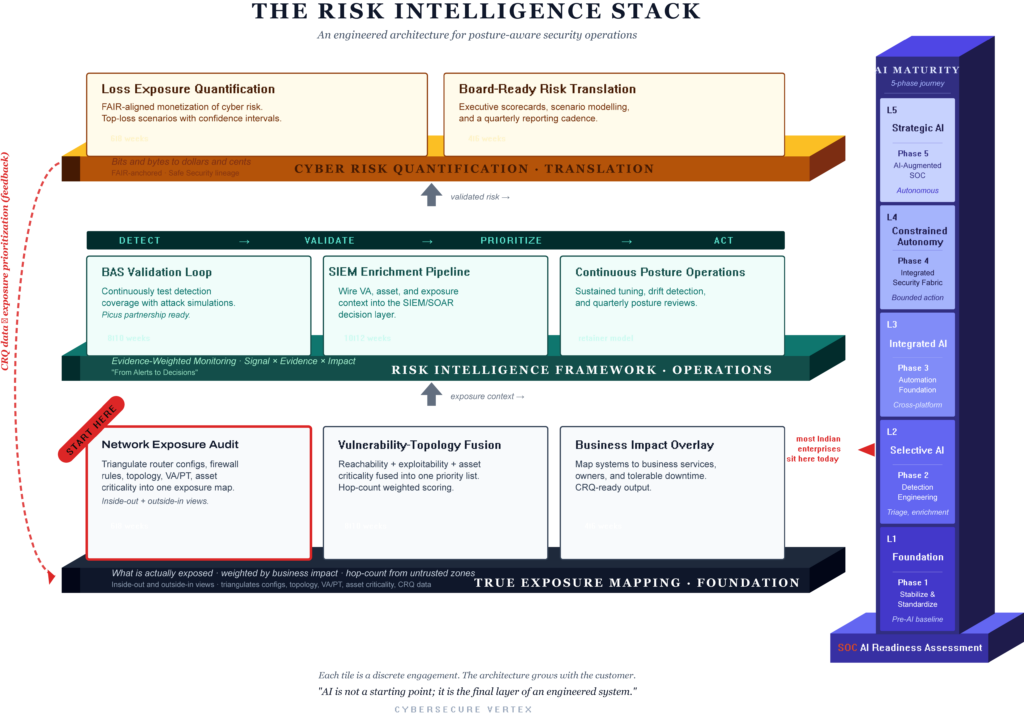
How the Stack Behaves as a System
The four layers do not just stack; they feed each other.
Foundation produces exposure context that flows up into Operations: which alerts are happening on what is actually reachable, exploitable, and business-critical. Operations produces validated risk that flows up into Translation: which incidents have business impact, and how confident are we. Translation produces monetary risk scoring that flows back down into Foundation: which exposures are most expensive in absolute terms, and should therefore be prioritized for remediation in the next cycle.
That feedback loop is what makes the Stack a system rather than a sequence of activities. It is also the architectural feature that, in my experience, distinguishes organizations whose risk posture is actually improving from those whose risk posture is being measured but not changing.
The Modulating Spine sits beside all three layers because AI is not a layer of its own — it is a setting applied to the layers below. The Spine ensures that the AI ambition matches the underlying engineering maturity, and not the other way around.
What This Architecture Is For
The Risk Intelligence Stack is not a product. It is a framework that organizes how I engage with organizations whose cybersecurity programs need to move from accumulation to engineering.
Each layer corresponds to a discrete engagement type: Network Exposure Audits, Vulnerability-Topology Fusion, and Business Impact Overlays at the Foundation layer; Detection Engineering, BAS Validation, and SIEM Enrichment Pipelines at the Operations layer; Loss Exposure Quantification and Board-Ready Risk Translation at the Translation layer; and the SOC AI Readiness Assessment that anchors the Spine. They are designed to be commissioned independently — most engagements begin at one layer and expand only when there is real value to expand into.
Customers can board the train at any stage. They can disembark when the value they came for has been delivered. The architecture is modular by design, because organizations arrive at this work from different starting points and most of them are not ready to commission everything at once.
What the architecture does not allow is engaging at higher layers without honesty about the lower ones. A CRQ engagement is not credible without the validated Operations data underneath. An Operations engagement is not credible without the True Exposure Map underneath. AI cannot be deployed at Level 4 or 5 without the engineering at Level 1 or 2 supporting it.
That is the engineering thesis the Stack carries: cybersecurity programs are not assembled; they are engineered, layer by layer, with each layer earning the right to host the next.
What Comes Next
I’ll be writing about each layer in detail over the coming months — From Alerts to Decisions and Sap the Silicon live in the Operations layer, with more pieces planned for Foundation and Translation. A whitepaper, An AI-Driven SOC Is Not Purchased; It Is Engineered, will publish later this quarter as the long-form expression of the Stack thesis.
For now: this is the framework. If your security operation has been growing through accumulation rather than engineering — and most have — the four-layer view above is one way to see what’s missing.
If you’ve been building toward something like this on your own, I’d be glad to compare notes.
— Damanjit Singh Uberoi · Founder, CyberSecure Vertex