
From Alerts to Decisions
Reframing Security Monitoring as a Risk Intelligence Function
There is a quiet but fundamental flaw at the heart of most Security Operations Centres (SOCs) today. It is so deeply embedded in the way SOCs are designed, staffed, and measured that it often escapes scrutiny. We have conditioned entire ecosystems — platforms, processes, and people — to react to alerts, not to risk.
At first glance, this may appear to be a minor distinction. In reality, it defines the difference between activity and consequence, between technical noise and business relevance. It also explains why many SOCs, despite significant investment, struggle to demonstrate proportional value to the organisations they serve.
The Illusion of Signal
Modern enterprise environments generate an overwhelming volume of telemetry. Security controls such as intrusion prevention systems, web application firewalls, endpoint detection tools, and identity platforms continuously emit events, many of which are escalated as alerts. These alerts are aggregated within SIEM platforms and presented to analysts as items requiring investigation. The implicit assumption is simple: if a control has generated an alert, it must be important.
In practice, this assumption does not hold. An IPS may detect an exploit attempt. A WAF may block a payload resembling SQL injection. An authentication system may register multiple failed logins. These are all legitimate signals. However, in isolation, they are incomplete. They answer the question “what happened?” They do not answer the question “does it matter in this environment?”
An alert is not a problem. It is a hypothesis awaiting validation.
Environmental Context — The Missing Dimension
The fundamental limitation of traditional SOC models is not a lack of detection capability. It is the absence of contextual validation.
Consider a seemingly high-severity scenario: an exploit attempt is detected against a server. In a conventional SOC, this event is escalated, investigated, and often treated as a priority incident. However, the following questions are rarely asked in a structured, automated manner:
- Is the vulnerability present on the endpoint?
- Is the relevant port open and reachable?
- Is the associated service even running?
- Is the system externally exposed or internally isolated?
- Is an impact to the system really a problem?
If the answers to these questions negate exploitability, or a wider room for concern, then the alert, while technically accurate, is operationally irrelevant. Detection without context is guesswork dressed up as certainty.
From Detection to Qualification
A deliberate shift from detection-centric operations to qualification-driven decision-making is required. Instead of reacting to alerts as definitive indicators, a mature SOC treats them as candidates for validation.
This introduces a second analytical layer:
- Validation of exploitability
- Confirmation of environmental relevance
- Assessment of business impact
This is where the integration of Vulnerability Assessment (VA) data and Asset Context (CMDB) becomes not just useful, but essential.
The Role of VA and Asset Intelligence
Most organisations already possess the foundational data required to make this transition:
- Vulnerability scan outputs
- Asset inventories and CMDBs
- Network exposure data (open ports, reachable services)
- Business criticality classifications
Yet, in most SOC implementations, this data remains siloed. Detection systems operate independently of vulnerability intelligence. Alerts are raised without awareness of whether the underlying condition is exploitable. Asset criticality is often applied superficially, if at all.
This disconnect leads to a paradox: the SOC has access to context but does not operationalise it. Most SOCs are not short of data. They are short of correlation between what they already know.
Introducing Evidence-Weighted Monitoring
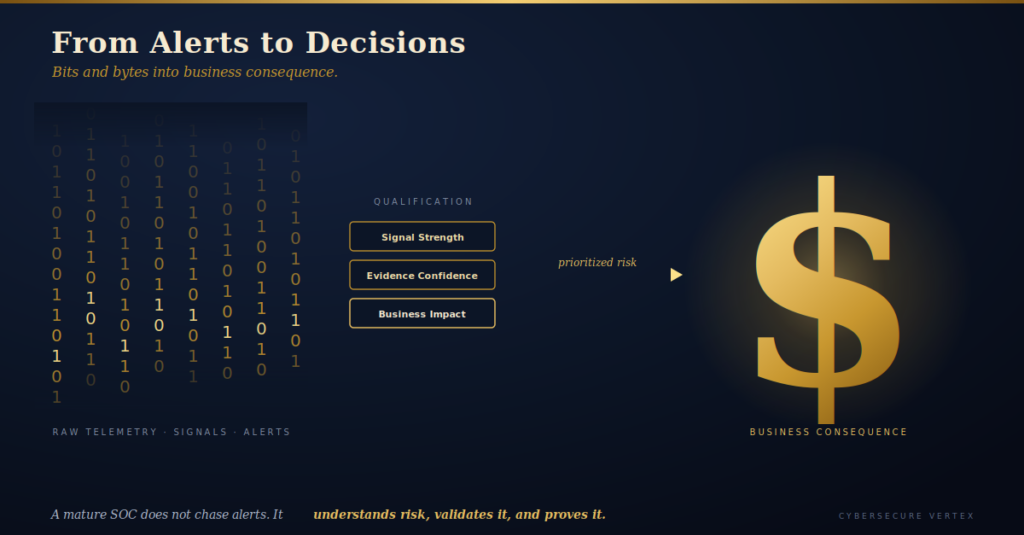
A more mature model introduces the concept of evidence-weighted monitoring. In this approach, every alert is evaluated across three dimensions:
- Signal Strength — what was detected? How severe is the raw event?
- Evidence Confidence — is the detected activity technically actionable in this environment?
- Business Impact — what is the consequence if the activity were successful?
This transforms the alert from a mere signal into an all-things-considered, multi-dimensional risk indicator.
Consider the following scenarios to illustrate the point further:
- An alert about a detected exploit attempt with no corresponding vulnerability and open/closed port information at the target could be a misleading, low-confidence one.
- The same attempt, when mapped against a vulnerable, exposed, critical system, would lead to a high-fidelity, high-confidence, meaningful and relevant alert.
The difference is not in the signal; it is in the evidence augmenting and supporting it. Severity is assigned by tools; real risk is established through evidence.
SOAR as the Decision Layer
Traditional SIEM platforms are highly effective at event aggregation and correlation. However, many of them are not designed to dynamically query external systems and recompute risk based on real-time contextual inputs. This is where orchestration platforms can become critical.
A SOAR platform can:
- Ingest alerts from SIEM
- Enrich them with vulnerability data, asset context, and exposure state
- Apply conditional logic
- Compute a composite risk score
- Adjust priority dynamically before analyst engagement
In doing so, it transforms the SOC from manual interpretation to automated qualification. Automation is not only about doing things faster; it is about making better decisions consistently.
The Human Element — Stakeholder Collaboration
A frequently overlooked aspect of this model is the active involvement of stakeholders. The following must be clearly defined and maintained for risk-based monitoring to be meaningful and effective:
- Asset criticality classifications
- Business service mappings
- Acceptable exposure thresholds
- Ownership of systems and applications
This cannot be inferred implicitly from technical telemetry. It requires deliberate collaboration between the SOC and concerned stakeholders. This is where the real value is unlocked in many engagements. The conversation shifts from “why are we getting so many alerts?” to “which of these conditions actually threaten our business operations?”
A SOC delivers value not by what it detects, but by what it helps the business prioritise.
Reframing the SOC’s Value Proposition
This approach fundamentally redefines what a SOC represents. Instead of delivering:
- Alert volumes
- Ticket counts
- Activity summaries
the SOC begins to deliver:
- Validated, evidence-backed risk insights
- Prioritised incidents aligned to business impact
- Reduced operational noise and analyst fatigue
This is the difference between monitoring a system and participating in risk mitigation.
Closing Thoughts
There is nothing inherently flawed about traditional SOC models. They are a product of their time — designed to process signals in environments where volume and complexity were lower.
Today, the landscape has changed. The volume of telemetry has increased. The expectations from security teams have evolved. The tolerance for inefficiency has diminished.
It is no longer sufficient to know what is happening. It is necessary to understand what matters, and to prove it in a compelling manner.
A mature SOC does not chase alerts. It understands risk, validates it, and communicates it in terms the business respects.
— Damanjit Singh Uberoi · Founder, CyberSecure Vertex