
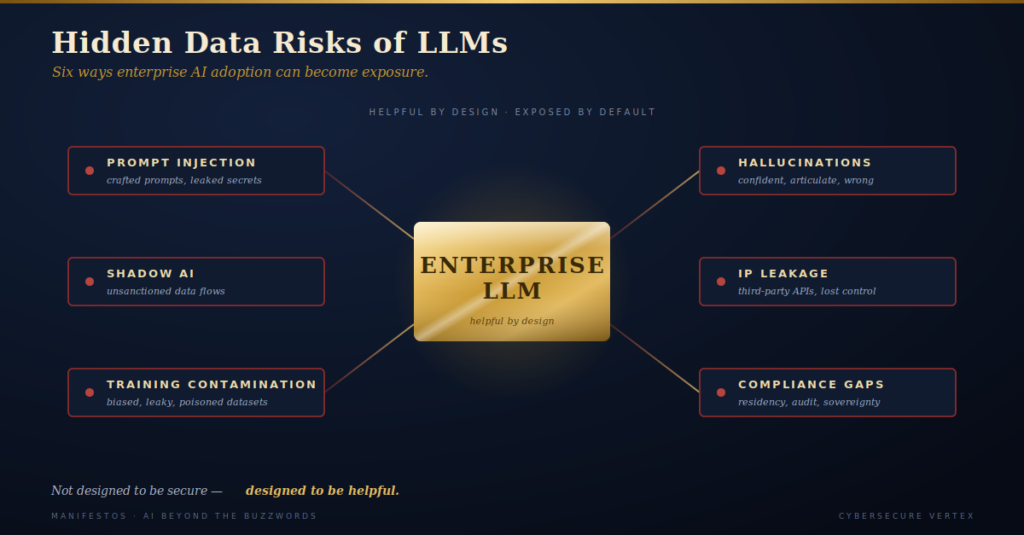
Hidden Data Risks of LLMs
Six ways enterprise AI adoption can become exposure.
Introduction
AI adoption has quickly evolved from boardroom curiosity to boardroom mandate. With tools like ChatGPT, Claude, and Gemini now embedded into daily workflows, enterprises stand on the edge of a transformational shift. Large Language Models (LLMs) are powering productivity, content generation, decision support, and even technical design.
These gains bring new, and often underestimated, risks. LLMs introduce a complex, evolving threat surface that most organizations are unprepared to secure. Worse still, premature or poorly guided AI adoption can expose even the most well-intentioned leadership to regulatory, reputational, and financial fallout.
This article explores the core technical threats to company data as LLMs take root in enterprise environments. It is written for security-aware leaders and technical decision-makers who must not only enable AI-driven innovation, but also safeguard the data it depends on. Each section highlights a key area of concern, outlines specific risks, and offers a framing insight to help enforce secure thinking. The goal: to equip you with the right questions, and to spark the right conversations as your organisation navigates this AI frontier.
Data Leakage via Prompt Injection
LLMs are not designed to be secure — they are designed to be helpful. Malicious users can manipulate model behaviour via specially crafted prompts (prompt injection), causing the model to divulge sensitive information.
Risks:
- Exposure of confidential documents used in training
- Accidental disclosure of internal prompt libraries or process logic
- Outputs that help attackers socially engineer employees
Customer-facing AI assistants can reveal internal knowledge base contents through clever questioning.
Shadow AI — Unmonitored LLM Usage
Many employees, in pursuit of productivity, are already using public AI tools without organisational approval. This introduces unsanctioned data flows outside your control.
Risks:
- Pasting sensitive data (source code, designs, contracts) into public tools like ChatGPT
- No guarantees on data retention, reuse, or deletion
- Legal or compliance violations depending on jurisdiction or industry
Any unapproved AI tool used for real work is a potential vector for intellectual property loss.
Training Data Contamination
Organisations fine-tuning LLMs on internal datasets may inadvertently include sensitive or misleading data — leading to downstream risks.
Risks:
- AI systems inheriting biased behaviour
- Reproduction of sensitive corporate content in generated output
- Model corruption through data poisoning attacks
Unfiltered email archives or chat logs make poor training sources.
Hallucinations as Business Risk
LLMs are confident, articulate, but not always correct. Even in enterprise scenarios, hallucinated output can be dangerously misleading.
Risks:
- Poor executive decisions based on inaccurate AI-generated summaries
- Legal or compliance missteps from hallucinated interpretations of regulations
- Technical errors introduced by AI-generated code with subtle flaws
The danger compounds when business leaders trust output without human review.
Intellectual Property Leakage
Even enterprise-grade AI platforms rely on third-party APIs. When internal data is sent to an LLM vendor, organisations may lose control over how that data is stored, retained, or reused.
Risks:
- Exposure of trade secrets or internal logic
- Cross-border data flow violations
- Legal grey zones around derivative data ownership
Understand your model provider’s data handling policy.
Data Sovereignty and Compliance Gaps
Where is your model running? What laws govern it? Who has access to inference logs?
Risks:
- Violations of data residency mandates (GDPR, HIPAA)
- Inability to provide audit trails in regulatory investigations
- Legal complications in cross-border breach scenarios
Many LLM platforms do not offer geographic inference isolation or compliance logging.
The Danger of Premature AI Adoption
Rushing into AI adoption without a security and governance framework is akin to deploying untested software directly into production.
Minefields to avoid:
- Pilots turning into production systems without oversight
- Undocumented dependencies on external AI infrastructure
- Lack of internal alignment on acceptable data exposure levels
- Untrained staff relying on AI-generated output in high-stakes workflows
Premature adoption isn't about bugs — it's about losing control of your data ecosystem before you even realize what's at stake.
Recommendations for Leadership
1. Define an LLM Security Policy. Restrict model use by data classification level. Mandate enterprise LLMs with internal logging and audit trails.
2. Enable Model Usage Governance. Maintain oversight on fine-tuning datasets. Embed guardrails and human-in-the-loop mechanisms.
3. Develop an LLM Red Teaming Programme. Simulate prompt injection and model misuse. Regularly test output hallucination boundaries.
4. Invest in Explainable AI and Model Auditing. Choose providers that support transparent reasoning chains. Maintain logs of prompt-output pairs for critical workflows.
5. Implement Data Minimisation Principles. Sanitise inputs before model access. Enforce least-privilege access to training and inference datasets.
Closing Thoughts
While LLMs are powerful enablers of business transformation, their integration must be purposefully calibrated — not just for performance and efficiency, but also for risk containment. These models are not just another IT investment; they represent a paradigm shift in how organisations use, share, and protect knowledge.
Enterprises that move fast must also move smart. Proactive by design, not reactive by default. Overlooking the emerging data risks can undermine the very resilience AI is meant to enhance.
Those who treat AI as a strategic asset must address its risks with the same seriousness reserved for any new class of critical infrastructure.
Security-first AI adoption is no longer optional — it is foundational.
— Damanjit Singh Uberoi · Founder, CyberSecure Vertex