
The Ground Floor: SIEM
Demystifying SIEM — the what, why, and how, for cybersecurity beginners.
Foreword
Expect to walk away with a solid foundational understanding of the thing called “SIEM” (pronounced SIM or SI-EM). You’ll learn where it fits in the broader security picture, what it does, why it matters, the functions it typically performs, and the kinds of outcomes organizations expect from it.
This isn’t a crash course to turn you into a SIEM expert, but it will give you the clarity and vocabulary to hold your own in an entry-level discussion, job screen, or training program. A post like this can also bridge the gap most fresh graduates contend with when transitioning from textbooks to real-world, commercially driven environments.
Two notes on how this is written:
- Industry buzzwords are highlighted so you sharpen your vocabulary and start sounding more “with it.”
- Analogies and soundbites appear throughout to make concepts stick and to give you something to repeat in conversation.
Of course, individual results may vary. There is no magic wand — you’ve got to start somewhere and keep at it. Good luck!
What Is SIEM?
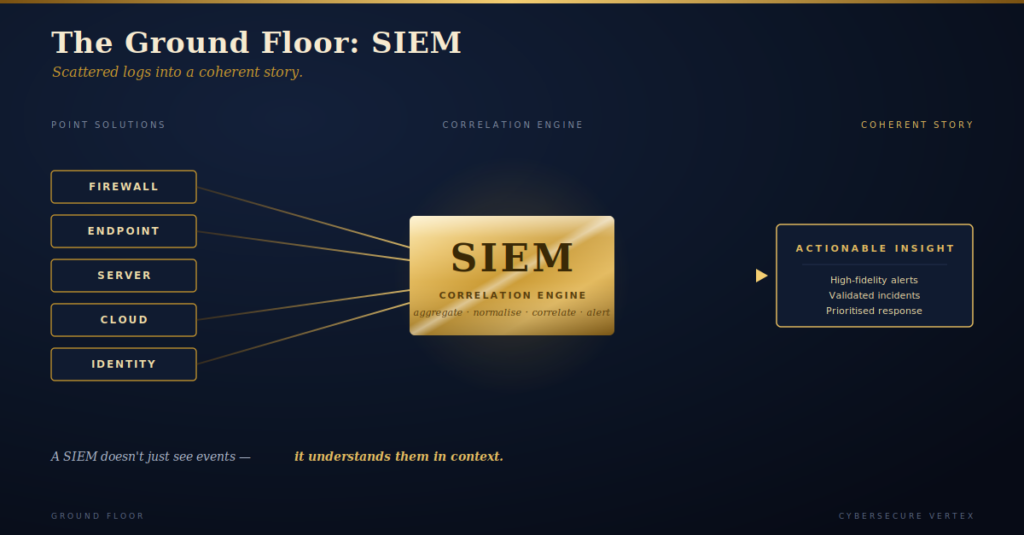
At its core, a SIEM platform (Security Information and Event Management) aggregates and analyses security data from across your digital environment. It brings logs from tools like firewalls, network detection systems, servers, endpoints, cloud platforms, and applications into a unified, wide-angle view. It does so by correlating these logs in real time to detect suspicious activity, security threats, or anomalies. This process turns raw data into actionable insight.
Let’s call these data-generating tools point-solutions — each designed for a specific purpose. Thinking this way helps build your conceptual model. Each point-solution logs its own perspective based on what it is built to observe. A firewall might show blocked traffic, while an endpoint protection platform might detect a malware execution attempt. Each tool works in isolation, blind to the bigger picture. None of them can see how their logs contribute to the overall narrative of an attack.
Without a collective vision, the story of cyber vigilance remains fragmented, and critical blind spots persist.
The Problem with Siloed Logs
The net effect of siloed logs is that you’ve got a rich but fragmented pool of data. This is akin to having puzzle pieces spread across multiple boxes — and to make matters worse, none of the boxes are labelled with the final picture.
In such a situation, the security analyst must:
- Manually retrieve logs from different tools
- Interpret them in native formats
- Cross-reference events to understand what happened
Another problem with this approach is that it hinges on a hypothesis of what may have happened, with the analyst then setting up queries to see whether that scenario actually occurred. This process is tedious, painstakingly slow, error-prone, and heavily dependent on the analyst’s knowledge, instincts, and assumptions.
In short: subjective and inconsistent. You could be barking up the wrong tree more often than not.
Enter SIEM
A modern SIEM solves this problem by:
- Ingesting logs from all those disparate point-solutions
- Correlating them in real time to detect incidents
- Using analytics and AI/ML to cast a wider net of possibilities and scenarios to consider
- Delivering actionable insights, higher-fidelity alerts, and suggested response steps
Think of it as a shared, intelligent canvas where all your scattered data points come together to reveal a coherent story.
The core feature behind this functionality is correlation — the ability to link disparate events across systems to identify suspicious patterns.
SIEM as a Decision Engine
A SIEM is more than a log collector. When leveraged correctly, it empowers your security team to:
- Filter out noise and false positives so they can concentrate on real, high-fidelity signals
- Detect incidents faster
- Respond with greater confidence
In a modern Security Operations Centre (SOC), SIEM acts as the backbone for:
- Real-time visibility
- Effective detection
- Merging risk and compliance factors with the cyber vigilance posture
The Security Guard Analogy
Imagine a building protected by CCTV cameras, motion detectors, and glass-break sensors — all feeding into a central guard room. There is a guard monitoring alarms and camera feeds. An intruder breaks a window to get in, while an accomplice tries to create a distraction by tripping an alarm elsewhere. The guard sees the alerts, connects the dots, prioritises the real threat, and takes action:
- Sounds an alarm
- Locks down the concerned hallway
- Calls the police
Now, map that to cybersecurity:
- The sensors are your point-solutions
- The guard room is your SIEM’s log aggregation layer
- The guard’s intuition is the SIEM’s correlation engine
- The response steps are incident response and management actions
A good SIEM doesn't just see events — it understands them in context. It is a smart decision engine, not just a log collector.
Why SIEM Matters
Today’s security teams face a volume and velocity problem. The SOC has to cope with thousands of events per second, dozens of tools, limited time, and analyst fatigue — to name a few. SIEM platforms help solve this by:
- Centralizing telemetry from disparate systems
- Detecting attacks through rules, pattern detection, and anomaly detection capabilities
- Providing actionable alerts, not just raw data
- Supporting compliance through retention and reporting
Beyond efficiency gains, the SIEM has another compelling value proposition: certain situations can only be uncovered by connecting the dots. Otherwise, they go unnoticed because their constituent events may appear harmless when viewed in isolation. When such events are viewed in light of each other — correlated by a SIEM — the real threat is brought to the fore.
Sometimes, two rights can make a wrong when they happen in parallel.
Whether it is detecting simple or multidimensional attacks, SIEM platforms play a central role in both proactive and reactive defense.
How SIEM Works
A functional SIEM pipeline typically includes:
- Data Collection — SIEMs ingest logs from sources like Windows Event Logs, firewalls, IDS/IPS systems, authentication servers, and cloud APIs.
- Normalization and Enrichment — Data is standardized into a common schema and enriched with threat intel, geolocation, or user context.
- Correlation and Detection — Logic rules, statistical models, or threat signatures analyse event patterns, triggering alerts when thresholds or matches occur.
- Alerting and Dashboards — Analysts receive prioritized alerts and can use dashboards to explore incidents, run queries, or pivot to threat hunting.
Getting Started
If you are early in your journey, the best way to skill up is to start experimenting. Free or community-driven tools like the Elastic Stack, Security Onion, or trial versions of Splunk can help you spin up a lab.
Focus on learning:
- What your logs are telling you
- How to write simple correlation rules
- How alerts are generated and triaged
These are foundational skills that map directly to SOC analyst and detection engineer roles. They scale upward into more advanced SIEM, SOAR, and threat detection work. Platforms like Splunk, Microsoft Sentinel, and QRadar are amongst the leaders in this space, each with their own strengths depending on enterprise needs and scale.
Closing Thoughts
SIEM isn’t about dashboards and buzzwords; it is about operational clarity. It is how you know what is happening, when to care, and how to act. Whether you are an aspiring analyst or a SIEM engineer building detection content, the path begins with understanding the fundamentals and building upward, deliberately.
You don’t need to memorise definitions — focus on grasping the role SIEM plays in a security ecosystem. From here, you’ll be better equipped to explore more advanced concepts like use cases, alert tuning, threat intelligence integration, and even SOAR (Security Orchestration, Automation, and Response).
Remember, even the best tools are only as good as the people wielding them.
— Damanjit Singh Uberoi · Founder, CyberSecure Vertex